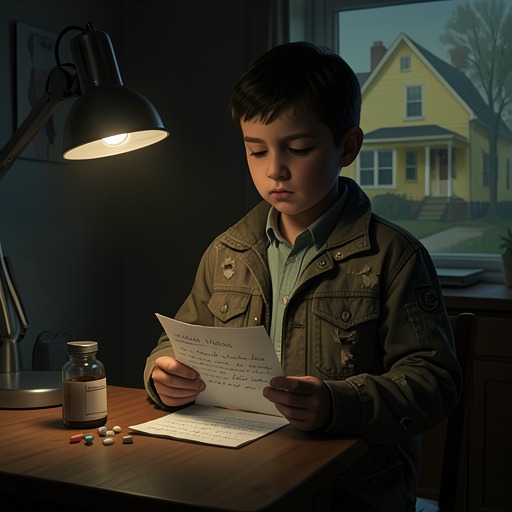
Markus Engseth
The SonMarkus Engseth is a clandestine observer whose fear and fascination converge around the yellow house. Hidden inside a wardrobe and later watching from a distance with binoculars, he becomes a quiet witness to its stillness and to the possibility that the family’s past may return in the form of a weapon.
Hiding and Exposure
After hearing a car start, Markus lets out a sigh of relief. He is crouched beneath the clothes in a wardrobe, his back pressed against its rear panel, and has never been so frightened. His T-shirt is soaked with sweat and clings to his body. The physical details make his terror immediate, but his response is not simply dread: he also finds the experience exhilarating.
He compares that sensation to falling from the ten-metre board at Frognerbadet’s diving pool, when he had thought that the worst possible outcome was death—and that even this might not be so terrible. The comparison links his present fear to the suspended instant before impact, when danger and a peculiar release coexist. Markus is not shown acting against anyone; his role here is that of a vulnerable, hidden witness, measuring danger through his own bodily response.
Watching the Yellow House
Later, Markus presses his eyes to binoculars and studies the moon above the yellow house before turning his attention to the house itself. It is completely still; nothing more has happened. His watchfulness nevertheless remains charged with expectation, because he hopes the son will return. The silence does not settle the question of what may happen there; it prolongs it.
The binoculars keep Markus physically apart from the house while concentrating his attention on it. His vigil turns an ordinary, motionless exterior into a scene of anticipated return. He watches not only for activity, but for what the son might do with the old thing lying in a drawer.
The Object in the Drawer
Markus remembers the object as gleaming and smelling of oil and metal. He wonders whether it is the weapon the father used, but the thought trails off before the passage identifies it conclusively or explains the circumstances of its use. The uncertainty is central to the image: the object is present in Markus’s mind as a possible link between father and son, past violence and a feared return.
His curiosity does not resolve into an investigation or an encounter. Instead, Markus yawns, notes that the day has been eventful, and expects to sleep soundly. The shift from the weapon’s ominous possibility to his ordinary tiredness leaves his fear and fascination side by side. In these brief scenes, Markus serves as a watchful outsider whose concealment, distance, and incomplete knowledge make the yellow house’s stillness feel temporary rather than reassuring.